Apple offered for the first time 2 TB of memory in the iPhone 17 Probut in the iPhone 18 Pro generation, the approach to the flash drive has changed. 256 and 512 GB models are used TLC NANDwhile the 1 and 2 TB versions received QLC NAND. Tests showed that after the cache is exhausted, the speed recording on QLC-memory can fall sharply.
The 1TB and 2TB iPhone 18 Pro use QLC
According to Homolab tests, in the iPhone 18 Pro line, Apple uses different types of NAND depending on the volume of the drive.
- 256 GB – TLC NAND
- 512 GB – TLC NAND
- 1 TB – QLC NAND
- 2 TB – QLC NAND
This is an important difference between configurations. Versions with a larger drive are not simply variants with more of the same flash memory. QLC can store four bits of data in one NAND cellwhile TLC keeps three. This allows manufacturers to increase storage capacity and reduce its cost. However, there is a trade-off: QLC typically has slower write speeds and less endurance compared to TLC.
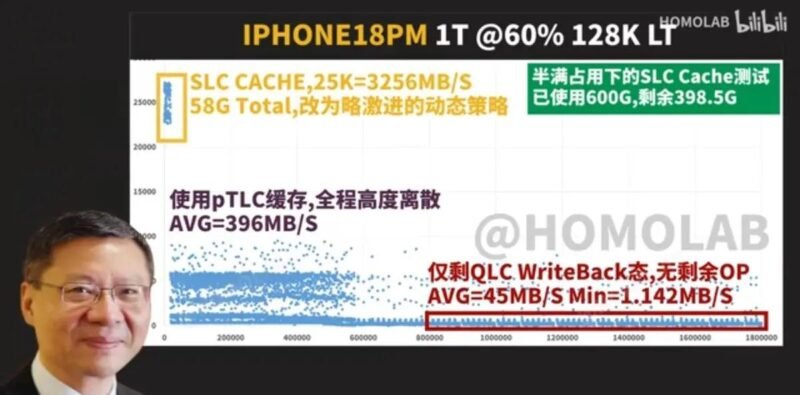
iPhone 18 Pro speed may drop from 3000 to 79 MB/s
Apple compensates for the features of QLC with a multi-level caching system. First, the data is written to the fast SLC cacheafter filling it – to the next level, and then directly to QLC NAND. In the test, an empty iPhone 18 Pro drive was able to show a recording speed of up to 3000 MB/swhen SLC cache was used. After it was filled, the speed dropped to approx 578 MB/s when writing through the next level of cache. The biggest drop occurred after all cache levels were filled. At this point, data began to be written directly to the QLC NAND, and the speed dropped to approx 79.4 MB/s. In some measurements, the result fell even to 25.6 MB/s. That doesn’t mean the iPhone 18 Pro will run at 25MB/s all the time. This scenario occurs when writing large amounts of data for a long time after running out of cache.
The cache becomes smaller as the drive fills up
There is one more feature of QLC configurations. The size of the fast SLC cache depends on how full the drive is. When the memory was practically empty, the cache in the test was close to 250 GB. When the drive was about 60% full, it shrunk to approx 58 GB. The speed of other caching levels also decreased. At 60% full, the TLC cache showed around 396 MB/s, while the long-term write speed directly to the QLC NAND in the test dropped to around 1.1 MB/s. It is this result that is the most extreme scenario of the test and does not characterize the usual speed of the iPhone during everyday use.
QLC isn’t just slower when recording
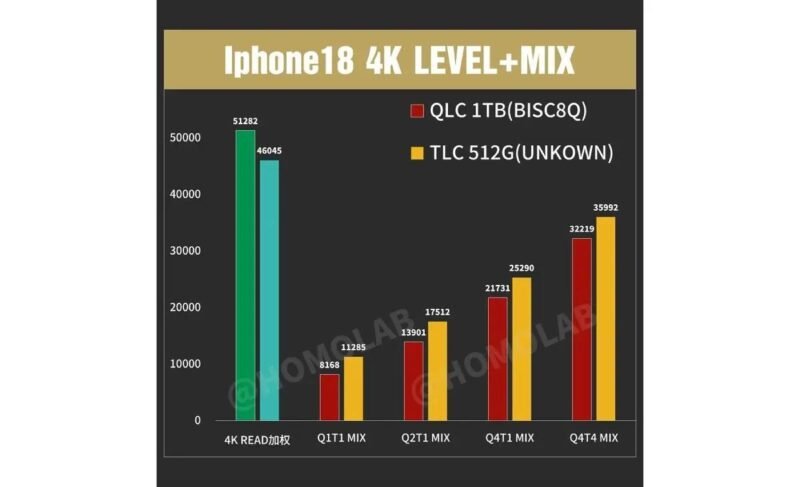
The difference between TLC and QLC also showed up in random reading tests. When testing 4K random read at low queue depth, the 1TB version of the iPhone 18 Pro Max with QLC was approx. 38% slowerthan the 512GB model with TLC. When the number of parallel requests increased, the gap narrowed to approx 12%. At the same time, the synthetic test does not mean that the 1TB iPhone 18 Pro Max will be 38% slower in normal use. Launching applications, browsing sites, working with messengers and typical camera shooting do not create the same load on the drive. The most noticeable difference can become during long-term recording of large volumes of data.
Why Apple switched to QLC
SLC, MLC, TLC, and QLC differ in the number of bits stored in a single NAND cell. The more information per cell, the higher the potential data storage density.
SLC stores one bit, MLC – two, TLC — three, a QLC — four bits per cell. This allows manufacturers to get large drives without proportionally increasing the number of NAND cells. The price of this approach is the lower performance and durability of QLC compared to TLC. It is especially interesting that The iPhone 17 Pro and iPhone 17 Pro Max used TLC NAND even in the 1 and 2 TB versions. Therefore, the switch to QLC in the iPhone 18 Pro and iPhone 18 Pro Max is a change in Apple’s approach to older memory configurations.
Will the average user notice the difference
In day-to-day work, most iPhone 18 Pro owners are unlikely to constantly encounter extreme test scores. The caching system hides the lower speed of QLC during short operations. The situation changes during long-term recording of large volumes of data, when the fast cache is filled. This is when the advantages of TLC over QLC become most apparent. Ago 1-TB and 2-TB versions of the iPhone 18 Pro should not be considered only as models with a larger amount of memory. They also use a different type of NAND that has excellent performance and endurance characteristics. At the same time, the final impact on the real durability of the iPhone 18 Pro still needs longer testing. Synthetic results show the difference between memory types, but do not automatically determine how noticeable it will be over several years of normal use.