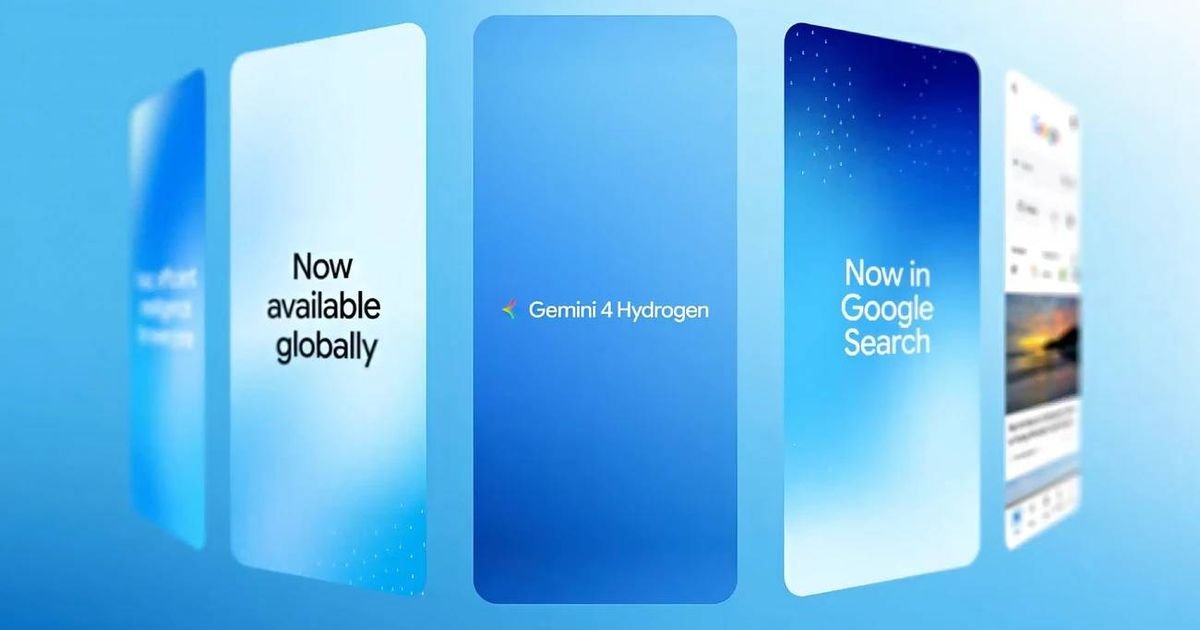
Gemini 4 Hydrogen — a new high-speed model Googlefocused on performing everyday tasks without long deliberation. It complements the line Gemini 4which also includes Carbon and Argon. While the latter two models are designed for more complex tasks with deep analysis, the Hydrogen should quickly help with writing, programming, research and working with files. Google is planning integrate Gemini 4 Hydrogen into the Gemini app, Google Search, AI Studio and enterprise tools. The company aims to make quick answers and actionable results more accessible, leaving more powerful models for tasks that require more processing time.
Gemini 4 Hydrogen bets on speed
Google calls Hydrogen a fast model for getting things done. Unlike Carbon and Argon, which focus on deep reasoning, it should be faster to handle typical queries. Users will be able to choose from four levels of reflection: low, medium, high, and x-high. For simple queries, a low level will be sufficient, while more complex tasks can be handed over to a model with more time to analyze. Another important feature is a context window with a volume of up to 1 million tokens. This makes it possible to process large documents, voluminous projects, and large code arrays without having to constantly divide them into smaller parts.
Google promises to speed up programming
One of the main uses of Gemini 4 Hydrogen is software development. The model will be able to help find errors, edit code, analyze large projects and run tests. According to Google, Hydrogen can perform certain programming tasks up to 2.5 times faster than Gemini 3.8 Flash. This does not mean that such a result will be achieved in every scenario, but it demonstrates the company’s priority: to reduce the time of practical work. Google is also integrating Orchestrator into Antigravity. This tool can distribute parts of the same task between different models. For example, Carbon will be responsible for planning, while Hydrogen will perform typical operations with code and testing. According to the results of Google’s internal tests, this approach made it possible to complete the task on 19% faster and on average use on 24% less than the quota. These indicators refer specifically to the company’s test scenarios, so they should not be automatically transferred to any real projects.
Gemini 4 Hydrogen will change Google search
Another direction of integration is Google Search. In AI Mode, Hydrogen will help process long queries that cover several topics at once. Google promises to make the answers more visual: they will be able to contain more images, comparison tables and specially designed tools. The search engine will also use more web pages to prepare results. This can make it easier for users to find information and compare products. At the same time, for independent publishers and technology media, in particular, GizChina Ukraine, such a change creates an additional risk. If Google increasingly shows expanded answers directly on the search page, some users may not go to the sites from which the information was obtained. This will potentially increase competition for organic traffic and make search visibility even more dependent on how Google uses publishers’ content.
Why is Google splitting the Gemini 4 models?
The appearance of Hydrogen shows that Google is developing not one universal model, but a whole system with different roles. Carbon and Argon are aimed at more complex tasks, while Hydrogen should ensure that everyday work is done quickly. This approach may be more practical than using the most powerful model for each query. For example, searching for information in a file or fixing a simple error in the code does not always require a lengthy multi-step analysis. It will also be important how imperceptibly for the user the transfer of tasks between models will work. If the system can independently determine when Hydrogen is enough and when Carbon or Argon is needed, it will simplify the work with AI. Google is announcing a gradual rollout of Hydrogen across consumer, developer, and enterprise products. The practical value of the new model will depend not only on the speed, but also on the quality of the answers in real scenarios.