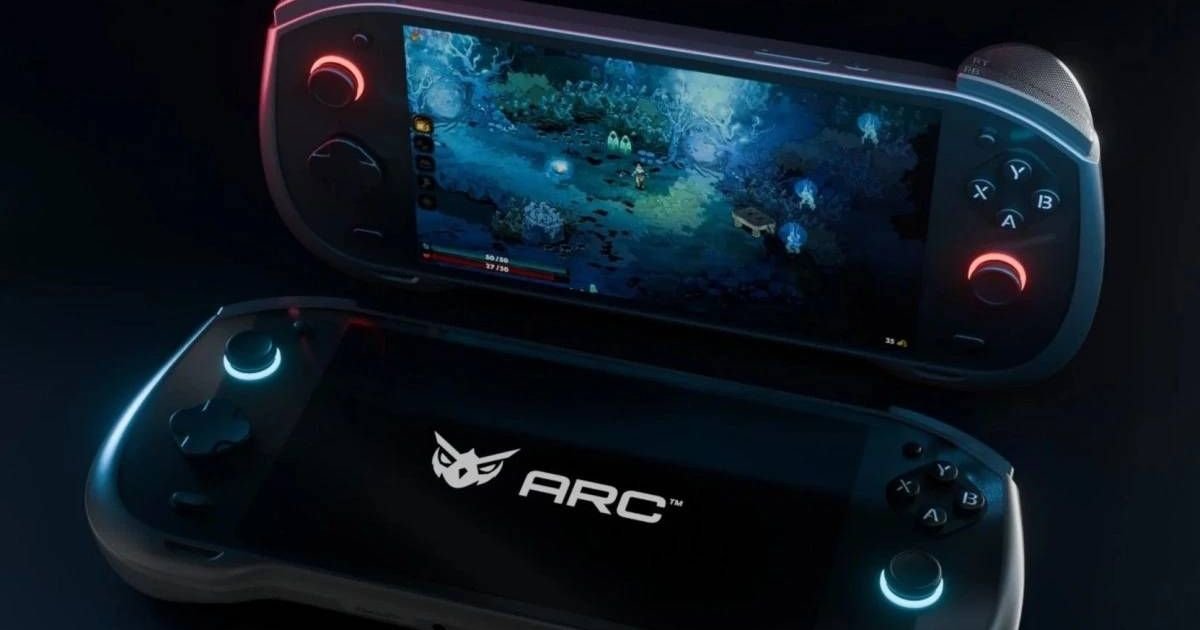
ARC enters the portable gaming market with the ARC X1 — Android-console on the Snapdragon G2 Gen 2. The device received a 7-inch 120 Hz screen, TMR sticks, Hall Effect triggers, active cooling and a 9300 mAh battery.
ARC X1 was over 16 months in the making
The ARC X1 was the company’s first portable gaming device. It was developed during 16 monthsinvolving representatives of the ARC gaming community in the process. One of the main features of the console was the operating system OwlOS — a modified version of Android based on AOSPwhich was not developed for a smartphone or tablet, but specifically for controlling physical buttons and joints. ARC has combined native Android games, cloud gaming and emulation in one interface. Games are available through a single library and launcher.

Snapdragon G2 Gen 2 and active cooling
At the heart of the ARC X1 lies Qualcomm Snapdragon G2 Gen 2manufactured using a 4-nm process. The processor received an 8-core Qualcomm Kryo CPU and graphics Adreno A22. Memory configuration includes:
- 8 GB LPDDR5X with a speed of 8533 MT/s;
- 128 GB UFS 3.1;
- microSDXC slot for cards up to 1 TB.
For long gaming sessions, ARC has installed an active cooling system. A centrifugal fan draws in air through the back of the case, after which the hot air exits through the top hole. The user can choose different profiles depending on the priority between performance, temperature, fan noise and autonomy. For a portable console, this is important, because the performance during a long game depends not only on the characteristics of the chip, but also on how long it can work without significant overheating and underclocking.
7-inch display at 120 Hz
ARC X1 received 7-inch Full HD LTPS TFT LCD with a resolution of 1920×1080 pixels. The main characteristics of the display:
- refresh rate 120 Hz;
- aspect ratio 16:9;
- brightness to 500 knots in typical mode;
- close 100% sRGB coverage;
- protective glass Corning Gorilla Glass 3.
The screen works alongside full physical controls, so the ARC X1 doesn’t depend on Android’s touch buttons when playing.

TMR sticks and Hall Effect triggers
For the control, ARC used components aimed at long-term operation. Analog sticks have technology TMRwhich is used to reduce the risk of drifting problems. Triggers work on the basis of Hall Effect and have mechanical locks to change their mode of operation. Also provided for:
- microswitches ABXY;
- D-pad microswitches;
- two programmable buttons on the back panel;
- stack calibration;
- separate control settings for different games;
- dual vibration feedback system based on LRA.
OwlOS allows you to create control profiles for individual games, so the user can adapt the physical buttons to a specific project.
OwlOS turns Android into a gaming console
Regular Android is not always convenient for a device that needs to be controlled mainly by buttons and sticks. This is exactly the problem ARC is trying to solve with OwlOS. The system received:
- a single library of games;
- launcher for portable mode;
- performance profiles for each game;
- button reconfiguration;
- resolution scaling;
- overlay with FPS indicator;
- adjustment of the fan operation curve;
- function Quick Resume.
OwlOS also combines Android games, cloud gaming and emulation in one interface.
9300 mAh battery
One of the most notable features of the ARC X1 was the battery on 9300 mAh. Charging is done via USB Power Delivery with power 27 W. ARC claims over 8 hours of battery life in Silent Modehowever the actual result will depend on the specific game, display brightness and selected performance mode. There is also a charging limitation mode up to 80%. It can help reduce battery drain during prolonged use of the console when plugged in.
ARC X1 will be repairable
Another feature of the device is attention to maintainability. ARC states that the battery and analog stick modules are replaceable. Internally, modular daughterboards are also used, which should simplify maintenance of individual components. For a portable console, this may be more important than another increase in performance: the most heavily loaded controls and battery will gradually wear out during active use.
Ports and wireless capabilities
ARC X1 supports Wi-Fi 6E and Bluetooth 5.4. USB-C 3.1 is used not only for charging, but also for data transfer and image output via DisplayPort. There is also USB OTG and traditional 3.5 mm audio jack. Sound is output through the front stereo speakers, and for voice communication there are two noise-canceling microphones. The weight of the console is approx 450–500 g.
ARC X1 price and sale date
Early access to ARC X1 starts October 2. Participants of the early ARC community will be able to purchase a console for 29,500 INRwhile the standard retail price will be 33,500 rupees. According to its characteristics, the ARC X1 tries to distinguish itself not only by the power of the Snapdragon. A large 9300 mAh battery, 120 Hz display, TMR-sticks, active cooling, controller-oriented OS and interchangeable modules make it interesting precisely as a specialized portable console. How well the Snapdragon G2 Gen 2 will reveal itself in real games under long-term load will become clear after the appearance of the first practical tests.